

In today’s life, plastic products are used quite commonly. For that reason, the demand for plastic products production has also increased, leading to an increase in wastewater. To effectively treat plastic production wastewater, what technology should be applied? The following article Biogency will answer for you.
Characteristics of plastic production wastewater
To produce a plastic product, the production process is quite complicated with many stages such as: creating plastic granules, collecting/sorting/cleaning, mixing colors, drawing plastic fibers, mixing additives, plastic molding, cutting and producing the final product. With such a complicated production process, wastewater is generated from many different sources:
- Waste water from the color mixing and cutting process to produce the final product.
- Wastewater from factory and equipment cleaning process.
- Waste water from cooling process for pipes and machinery.
- Wastewater from the factory kitchen.
- Wastewater from cleaning process of factory workers.
- etc.
Plastic production wastewater has a rather complex composition with many different pollutants, characterized by high COD content, low BOD/COD ratio, difficult-to-decompose COD; lots of Nitrogen, Phosphorus, surfactants and pathogenic microorganisms.
The table below is an example of the input pollution parameters of a current plastic manufacturing plant:
| STT | Parameter | Unit | Input value | QCVN 40:2011/BTNMT | |
| Column A | Column B | ||||
| 1 | pH | – | 6.2 – 6.6 | 6 – 9 | 5.5 – 9 |
| 2 | BOD5 | mg/l | 75 – 150 | 30 | 50 |
| 3 | COD | mg/l | 650 – 3200 | 75 | 150 |
| 4 | TSS | mg/l | 350 – 500 | 50 | 100 |
| 5 | Total Nitrogen | mg/l | 10 – 20 | 20 | 40 |
| 6 | Total Phosphorus | mg/l | 3 – 5 | 4 | 6 |
| 7 | Grease | mg/l | 3 – 5 | 5 | 10 |
Current technology for treating plastic production wastewater
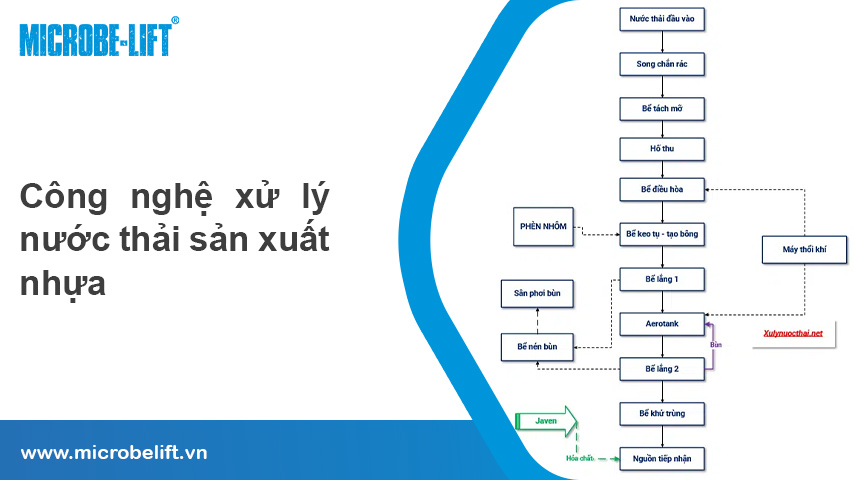
To effectively treat pollution indicators in plastic production wastewater, the technology commonly applied is a combination of chemistry and biology. A typical wastewater treatment system diagram is as follows:
The advantages of this plastic production wastewater treatment technology are:
- Capable of treating all pollutants in plastic production wastewater, from surfactants to organic pollutants such as BOD, COD, TSS.
- Minimize the amount of sludge discharged.
- Wastewater can be reused after treatment.
- Operating costs are not too high due to the combination with biological methods to treat organic pollutants.
The specific technological process for treating plastic production wastewater is as follows:
- At the trash rack – grease trap: Wastewater after the production process passes through the trash rack to retain trash residue and insoluble plastic substances, then flows through the grease trap to filter out grease and flows through the equalization tank.
- At the equalization tank, wastewater is continuously mixed to ensure no organic decomposition occurs and parameters such as pH, alkalinity, etc. are controlled, then flow through the coagulation-flocculation tank.
- At the coagulation-flocculation tank: 2 processes take place here: coagulation to break the stable state of colloidal particles and flocculation to bond small colloidal particles into larger colloidal particles. Coagulation-flocculation chemicals are added to make the reaction easier, then the wastewater flows through settling tank 1.
- At settling tank 1: At settling tank 1, the dirt after coagulation and flocculation will be settled and taken out for treatment (sludge compression – sludge drying). The wastewater is brought into the Aerotank.
- At Aerotank: Dissolved oxygen is continuously supplied to this tank through the air blowing and aeration system. Biological wastewater treatment method is applied here. Microorganisms will use their growth and development mechanism to decompose organic pollutants such as BOD, COD, TSS… into CO2 and water. For microorganisms to work effectively, there are some factors that operating engineers need to pay attention to:
- Additional contact materials should be added to increase the contact between wastewater and microorganisms (e.g., substrates), and at the same time create conditions for microorganisms to adhere and grow better.
- Control environmental conditions, especially DO, pH, and alkalinity, so that microorganisms have the most favorable environment for growth and treatment of pollutants.
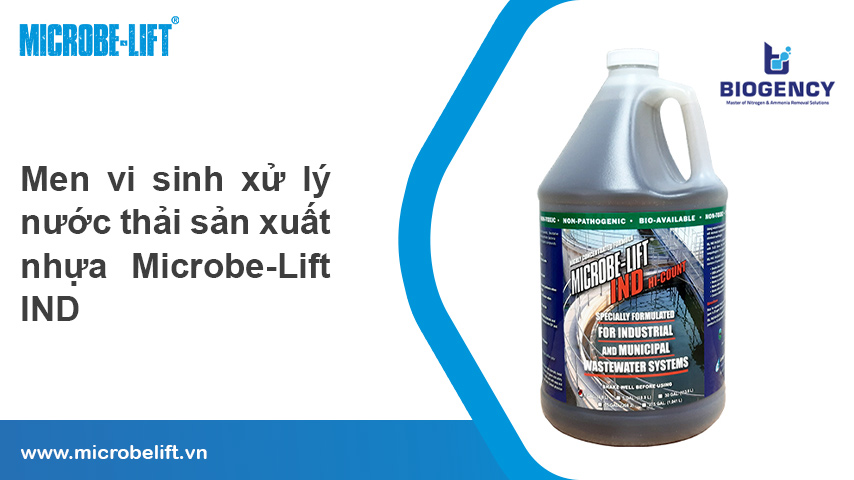
- To speed up the plastic wastewater treatment process, Microbe-Lift IND yeast should be added periodically to increase the density of microorganisms in the tank. Microbe-Lift IND is a yeast line containing up to 13 different strains of microorganisms, capable of being 5-10 times more active than native microorganisms, and is especially effective in treating BOD, COD, TSS and denitrifying.
After treating organic pollutants, wastewater will flow through settling tank 2.
- At settling tank 2: This tank will settle the sludge generated from the biological treatment process. Part of the sludge will be circulated to the Aerotank to continue treating the pollutants, the rest will be discharged. The wastewater will be sent to the disinfection tank.
- At the disinfection tank: This tank is responsible for treating microorganisms/bacteria to an allowable density before releasing standard wastewater into the environment.
Reference:
If your plastic production wastewater treatment system is having difficulty in treating pollutants, please contact us via Hotline 0909 538 514 for the fastest support!