

Compost is a type of organic fertilizer that is very popular with farmers because the raw materials are easy to find and especially can be self-produced. This helps farmers save a lot of costs and brings high efficiency to farming productivity. However, in the composting process (refer to the Compost composting process ), there are many factors that affect compost that not everyone knows.
- Factors affecting compost
- Using MICROBE-LIFT IND probiotics to help treat odors and decompose organic matter quickly
Factors affecting compost
Compost input materials
+ Input materials will greatly affect the composting process, composting time, humus quality, etc.
+ In addition, the carbon/nitrogen ratio (C/N) is also considered an element that affects the composting process. Carbon provides energy to build cells, nitrogen helps microorganisms grow and develop. If nitrogen exceeds the standard, NH3 will form, causing an unpleasant odor to the compost.
+ 21/1 to 45/1 is the optimal C/N ratio in the composting process, this ratio depends on each different type of raw material.
We have the following table of suitable C/N ratios according to fuel:
| Type | C/N ratio |
| Cow dung (manure) | January 20 |
| Coir | 66/1 |
| Straw | 80/1 |
| Corn stalks | 60/1 |
| Leaf | 35/1-85/1 |
| Peat | 58/1 |
| Rice bran | 48/1 |
| Sawdust (2 months) | 625/1 |
| Newspaper | 170/1 |
| Household waste (organic) | January 10-15 |
Environmental factors
Temperature
Temperature control is extremely important for microorganisms to function stably during the incubation process. Incubation temperature depends mainly on factors such as size, air, humidity, and C/N ratio.
The temperature of about 50-55 degrees Celsius is the optimal temperature for composting. During the composting process, the temperature will continuously increase, but if it increases above 70 degrees Celsius, the decomposing microorganisms may be destroyed. Therefore, turning the compost regularly will help regulate the temperature and reduce the temperature significantly. At the end of the stage. At the end of the process, the temperature drops to about 35 degrees Celsius, the composting process is complete.
Humidity
Water is needed for the process of dissolving nutrients into cells. The maximum allowable humidity is 50-60%. Living organisms play a decisive role in the composting process, it helps decompose raw materials, often forming a thin film of water on the surface of the molecules of the raw materials.
Water is a very important factor for the process of dissolving nutrients in cells, so a humidity of about 50 – 60% is suitable.
If the humidity is lower than 30%, the microorganisms will be less active, on the contrary, if the humidity is higher than 65%, the decomposition process will slow down and turn into anaerobic compost. Because when the humidity is high, the water molecules are covered, not allowing air to enter, leading to bad odors, reducing nutrients and increasing pathogenic bacteria. In case the compost is too dry, you can spray mist or water directly with enough amount for the mass, but if the mass is too wet, you should mix well to reduce the humidity.
Physical factors
Particle size
The aerobic decomposition process takes place on the surface, so the size of the raw material particles greatly affects the decomposition rate. Therefore, the larger the surface area, the more oxygen the materials are exposed to, thereby the decomposition rate will be faster. The optimal particle size is about 3-50mm in diameter. You can use cutting, chopping, grinding, etc. methods with the material to get the appropriate size for the composting process.
Compost pile fluffiness
Similar to the size, high porosity also helps increase the composting process. Porosity will be optimized for each different type of material, usually the suitable porosity for the composting process is 30-60%, best at 32-36%. It is possible to add a suitable proportion of structural materials to create porosity such as straw, stubble, grass, etc.
Size and design of the composting system
To be able to optimally control temperature, humidity, and provide enough oxygen, you need to choose a suitable composting system. Depending on the need for the amount of fuel to be processed, you can choose the processing material, which can be the size of long beds, compost piles, or mechanical composting equipment, etc.
Blowing air
Microorganisms in the compost pile use oxygen supplied from the surrounding environment to decompose organic matter or cool down. If the amount of oxygen is not enough, the compost mass is very likely to appear anaerobic zones and generate bad odors. Usually, to provide oxygen, people often use mixing, inserting bamboo tubes, blowing air, etc., but the blowing method is much more effective. With a blowing speed of about 5-10m3 of air/ton of raw materials/hour. It will be very suitable for large-scale composting, serving production.
Reference: Instructions for composting at home
Using MICROBE-LIFT IND probiotics to help treat odors and decompose organic matter quickly
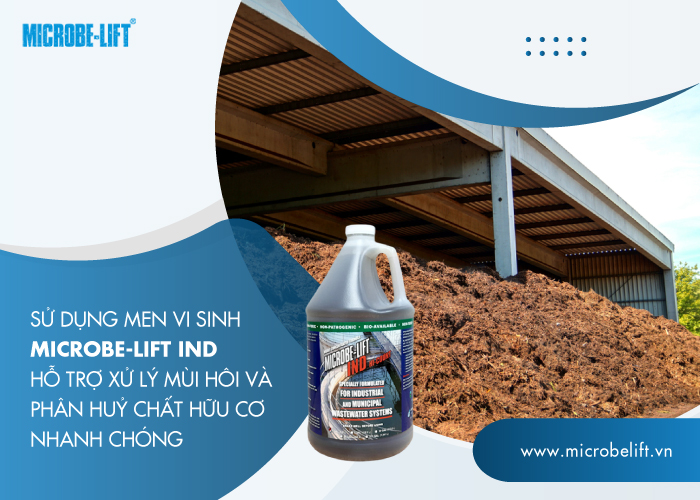
A brief introduction to Microbe-Lift IND probiotics
- Researched and manufactured in the USA
- The product contains a population of isolated microorganisms, cultured in liquid form, which is 5-10 times more effective than conventional microorganisms.
- Each type of microorganism cultured in Microbe-Lift IND has a different role and adaptability.
- Yeast helps maximize the efficiency of organic matter decomposition for the entire system.
Steps to use Microbe-Lift IND yeast in composting
Microbe-Lift composts more efficiently. Here are the steps you need to follow:
– Dilute Microbe-lift IND probiotics with water at a ratio of 1:50 or 1:100 (depending on the compost material).
– Use 2-4 liters of mixed solution for 1 m3 of compost material.
– Spray the mixed solution evenly into the compost material for the first 1 to 2 weeks.
See more: How to reduce odor when composting with microorganisms
__________________________
Above, Biogency has shared with you the factors that affect compost and how to use Microbe-Lift IND to increase processing efficiency. Hopefully, it will help you complete a complete compost treatment system.
For advice and answers to questions about wastewater treatment methods, please contact us immediately via HOTLINE: 0909 538 514