

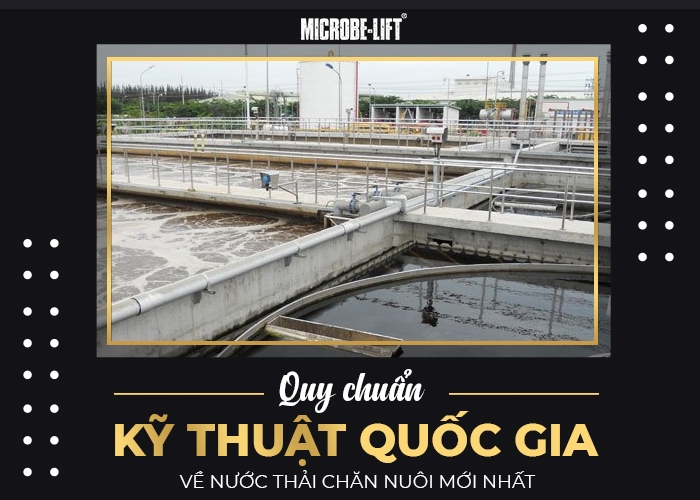
Livestock wastewater standards stipulate the maximum allowable values of pollution parameters in livestock wastewater when discharged into receiving sources. This helps the system achieve its treatment goals, minimizing impacts on the environment as well as human health.
National technical regulation on livestock wastewater
Livestock wastewater standard QCVN 62-MT:2016/BTNMT was compiled by the National Technical Regulation Drafting Team on Livestock Wastewater, approved by the General Department of Environment, Department of Science and Technology, Department of Legal Affairs and issued under Circular No. 04/2016/TT-BTNMT dated April 29, 2016 of the Minister of Natural Resources and Environment.
This standard applies only to livestock wastewater. All organizations and individuals involved in the discharge of livestock wastewater into wastewater receiving sources must comply with the provisions of this standard. Livestock wastewater discharged into the collection system of a centralized wastewater treatment plant must comply with the regulations of the unit managing and operating the centralized wastewater treatment plant.
Technical regulations
Regulations for livestock facilities with total wastewater volume greater than or equal to 5 cubic meters per day (m3/day).
The maximum allowable values of pollution parameters in livestock wastewater when discharged into wastewater receiving sources are calculated according to the following formula:
C max = C x K q x K f
In there:
- Cmax is the maximum allowable value of pollution parameters in livestock wastewater when discharged into wastewater receiving sources;
- C is the value of the pollution parameter in livestock wastewater specified in section 2.1.2;
- Kq is the coefficient of wastewater receiving source specified in section 2.1.3 corresponding to the flow rate of rivers, streams, creeks, canals, ditches; capacity of lakes, ponds, lagoons, estuaries; purpose of use of coastal seawater;
- Kf is the wastewater flow coefficient specified in section 2.1.4 corresponding to the total wastewater flow of livestock facilities when discharged into wastewater receiving sources.
Apply the maximum allowable value Cmax = C (without applying the coefficients Kq and Kf) to the pH and total coliform parameters.
Livestock wastewater discharged into urban drainage systems and residential areas without centralized wastewater treatment plants shall apply the value Cmax = C specified in column B. The value C is the basis for calculating the maximum allowable value of pollution parameters.
Table 1: C values as a basis for calculating the maximum allowable values of pollution parameters in livestock wastewater
| TT | Parameter | Unit | C value | |
| A | B | |||
| 1 | pH | – | 6-9 | 5.5-9 |
| 2 | BOD 5 | mg/l | 40 | 100 |
| 3 | COD | mg/l | 100 | 300 |
| 4 | Total suspended solids | mg/l | 50 | 150 |
| 5 | Total Nitrogen (as N) | mg/l | 50 | 150 |
| 6 | Total Coliform | MPN or CFU/100 ml | 3000 | 5000 |
Column A of Table 1 specifies the C values of pollution parameters in livestock wastewater when discharged into water sources used for domestic water supply purposes.
Column B of Table 1 specifies the C values of pollution parameters in livestock wastewater when discharged into water sources not used for domestic water supply purposes.
The intended use of the wastewater receiving source is determined at the wastewater receiving area.
Wastewater receiving source coefficient Kq
Coefficient Kq corresponding to the flow rate of rivers, streams, creeks, canals, and ditches is specified in Table 2 below:
Table 2: Coefficient K q corresponding to the flow rate of the wastewater receiving source
| Flow rate of wastewater receiving source (Q) Unit: cubic meter/second (m3/s) | Kq coefficient |
| Q ≤ 50 | 0.9 |
| 50 < Q ≤ 200 | 1 |
| 200 < Q ≤ 500 | 1.1 |
| Q > 500 | 1.2 |
Q is calculated based on the average flow value of the wastewater receiving source during the 3 driest months in 3 consecutive years (data from the Hydrometeorological Agency).
Coefficient Kq corresponding to the capacity of wastewater receiving sources such as lakes, ponds, and lagoons is specified in Table 3 below:
Table 3: Coefficient K q corresponding to the capacity of the wastewater receiving source
| Capacity of wastewater receiving source (V) Unit: cubic meter (m3) | Kq coefficient |
| V ≤ 10 x 106 | 0.6 |
| 10 x 106 < V ≤ 100 x 106 | 0.8 |
| V > 100 x 106 | 1.0 |
V is calculated based on the average capacity of lakes, ponds, and lagoons receiving wastewater during the three driest months of three consecutive years (data from the Hydrometeorological Agency).
When the wastewater receiving source does not have data on the flow rate of rivers, streams, creeks, canals, or ditches, the coefficient value Kq = 0.9 is applied; when the wastewater receiving source is a lake, pond, or lagoon and does not have data on its capacity, the coefficient value Kq = 0.6 is applied.
Coefficient Kq for wastewater receiving sources is coastal seawater, saltwater lagoons and brackish coastal water.
Coastal seawater used for aquaculture, aquatic conservation, bathing beaches, water sports, saltwater lagoons and brackish coastal water apply coefficient value Kq = 1.
Coastal waters not used for aquaculture, aquatic conservation, bathing, and water sports apply coefficient value Kq = 1.3.
Wastewater flow coefficient K f
The discharge flow coefficient Kf is specified in Table 4 below:
Table 4: Wastewater flow coefficient K f
| Discharge flow rate (F) Unit: cubic meter per day (m3/day) | Kf coefficient |
| 5 ≤ F ≤ 50 | 1.3 |
| 50 < F ≤ 100 | 1.2 |
| 100 < F ≤ 200 | 1.1 |
| 200 < F ≤ 300 | 1.0 |
| F > 300 | 0.9 |
The discharge flow rate F is calculated based on the largest discharge flow rate stated in the Environmental Impact Assessment Report, Environmental Protection Commitment, Environmental Protection Project, Environmental Protection Plan, or Certificate of Completion of Environmental Protection Works approved by a competent authority.
When the discharge flow F changes and is no longer consistent with the applied coefficient Kf value, the livestock facility must report to the competent authority to adjust the coefficient Kf.
Technical regulations for livestock facilities with total wastewater volume less than 5 cubic meters per day (m 3 /day)
Livestock facilities with a total wastewater volume of less than 2 m3/day must have a sanitary wastewater collection and settling and composting system.
Livestock facilities with a total wastewater volume from 2 m3/day to less than 5 m3/day must have a collection system and a waste treatment system with sufficient capacity such as biogas (biogas system) or biological bedding that meets National Standards.
METHOD OF DETERMINATION
The method of sampling and determining the values of parameters in livestock wastewater is carried out according to the following standards:
| TT | Parameter | Analysis method, standard number |
| 1 | Sample | – TCVN 6663-1:2011 (ISO 5667-1:2006) – Water quality – Part 1: Guidance on sampling programs and sampling techniques; – TCVN 6663-3:2008 (ISO 5667-3: 2003) – Water quality – Sampling. Guidance on sample preservation and handling; – TCVN 5999:1995 (ISO 5667-10: 1992) – Water quality – Sampling. Guidance on wastewater sampling. |
| 2 | pH | – TCVN 6492:2011 (ISO 10523:2008) Water quality– Determine pH; – SMEWW 2550 B – Standard methods for the analysis of water and wastewater – Determination of pH. |
| 3 | BOD5 (20°C) | – TCVN 6001-1:2008 (ISO 5815-1:2003), Water quality – Determination of biochemical oxygen demand after n days (BODn) – Part 1: Dilution and inoculation method with allylthiourea addition; – TCVN 6001-2:2008 (ISO 5815-2:2003), Water quality – Determination of biochemical oxygen demand after n days (BODn) – Part 2: Method for undiluted samples;– SMEWW 5210 B – Standard Methods for the Analysis of Water and Wastewater – BOD Determination. |
| 4 | COD | – TCVN 6491:1999 (ISO 6060:1989) Water quality – Determination of chemical oxygen demand (COD); – SMEWW 5220 – Standard Methods for the Analysis of Water and Wastewater – COD Determination. |
| 5 | Total suspended solids | – TCVN 6625:2000 (ISO 11923:1997) Water quality– Determination of suspended solids by filtration through a glass fiber filter; – SMEWW 2540 – Standard Methods for the Analysis of Water and Wastewater – Determination of Suspended Solids. |
| 6 | Total nitrogen (N) | – TCVN 6638:2000 Water quality – Determination of nitrogen – Catalytic inorganication after reduction with Devarda alloy; – SMEWW 4500-NC – Standard methods for the analysis of water and wastewater – Determination of nitrogen. |
| 7 | Total Coliforms | – TCVN 6187-1:2009 Water quality – Detection and enumeration of escherichia coli and coliform bacteria. Part 1: Membrane filtration method; – TCVN 6187-2:1996 Water quality – Detection and enumeration of escherichia coli and coliform bacteria. Part 2: Multiple tube method (most probable);– TCVN 8775:2011 – Water quality – Determination of total coliform – Membrane filtration technique;– SMEWW 9222 B – Standard methods for the analysis of water and wastewater – Determination of coliforms. |
Accept the analytical methods specified in other national and international standards with accuracy equivalent to or higher than the standards cited above.
Contact Hotline 0909 538 514 for detailed consulting support on livestock wastewater standards as well as standard and cost-optimized treatment methods.
>>> Reference: Top 3 ways to treat pig waste effectively and economically