

The process of treating wastewater from ceramic production needs to remove suspended substances and organic substances for the treatment to be effective. Below Biogency will inform you of a typical current process of treating wastewater from ceramic production.
- Current status of ceramic production wastewater treatment in Vietnam
- Composition of wastewater from ceramic production
- Which process is applied to effectively treat ceramic production wastewater?
Current status of ceramic production wastewater treatment in Vietnam
Ceramics is a long-standing industry in Vietnam. Over many years of development, the ceramics industry has brought to the market many quality products with impressive designs imbued with cultural identity, while also creating jobs for many workers. However, wastewater from ceramic production facilities is a concern for the environment because it has not been centrally treated.
A typical example is the Bat Trang ceramic production area (Hanoi). With more than 20 years of development, the people in the area have also had to live with environmental pollution from ceramic production wastewater. The Red River has to receive black, foul-smelling water from ceramic factories every day.
Composition of wastewater from ceramic production
Ceramic production wastewater is mainly generated from the processes of soaking soil, mixing coal, glazing, cleaning/washing tools, equipment, workshops and the living activities of workers in the workshop.
Because the raw materials are mainly produced from clay, the composition of this type of wastewater contains a lot of suspended solids, in addition to high color from the glazing process and organic substances from the cleaning/living activities of workers.
Below is an example table of input pollution parameters of ceramic production wastewater:
| STT | Category | Unit of measurement | Pollution value |
| 1 | pH | 6-9 | |
| 2 | BOD5 | mg/l | 310-400 |
| 3 | COD | mg/l | 464-553 |
| 4 | SS | mg/l | 395-511 |
| 5 | Nitrogen | mg/l | 90-120 |
| 6 | Phosphorus | mg/l | 50-70 |
If there is no suitable treatment method for ceramic production wastewater to remove pollutants before discharging into the environment, this wastewater will accumulate in many sewers and anaerobic decomposition will occur, causing the generation of many types of gases that cause unpleasant odors. At the same time, pollutants when seeping into the ground will pollute the soil environment, leading to a decline in groundwater quality.
Which process is applied to effectively treat ceramic production wastewater?
With the above characteristics of wastewater composition, the process of treating wastewater from ceramic production needs to remove suspended substances and organic substances for the treatment to be effective. Below Biogency will inform you of a typical current process of treating wastewater from ceramic production:
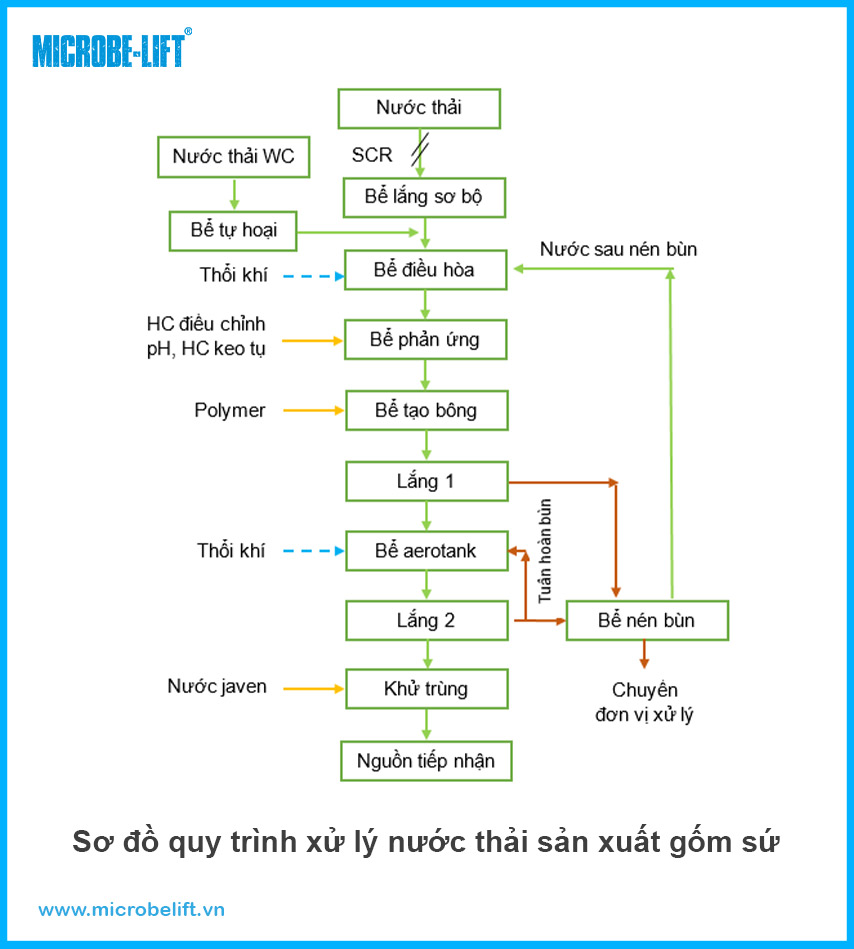
Detailed description of ceramic production wastewater treatment process:
- Production wastewater is collected, filtered and sent to the primary settling tank . At the same time, wastewater from the daily activities of workers is also collected in the septic tank and then sent to this tank. In the primary settling tank, solids that are larger and heavier than water will settle to the bottom and be removed. The wastewater will continue to be sent to the equalization tank.
- At the equalization tank , the wastewater will be re-regulated in terms of speed, flow rate and concentration of pollutants. Then, the wastewater is pumped into the reaction tank.
- At the reaction tank , pH adjusting chemicals will be added to bring the wastewater to the appropriate pH for the coagulation process. Then, coagulant chemicals will be added to the tank to coagulate the suspended solids in the water. When the reaction is finished, the wastewater will be transferred to the flocculation tank.
- At the flocculation tank , flocculating chemicals will be added (e.g. Polymer). With the action of the stirring blades, the flocculating particles will be flocculated into flocs. Then the wastewater will be transferred to the settling tank 1.
- At settling tank 1 , the flocs will be settled and removed, the wastewater will be led to the Aerotank to treat organic pollutants.
- At the Aerotank , aerobic microorganisms will decompose organic substances in wastewater. Here, the BOD, COD and remaining suspended solids (TSS) will be removed. Next, the wastewater will be transferred to the second settling tank.
- At settling tank 2 , wastewater is settled to remove biological sludge. The clear water will be sent to the disinfection tank.
- At the disinfection tank , disinfectants will be added to treat bacteria, viruses, fungi… in the wastewater so that the output wastewater meets QCVN 40:2011/BTNMT standards.
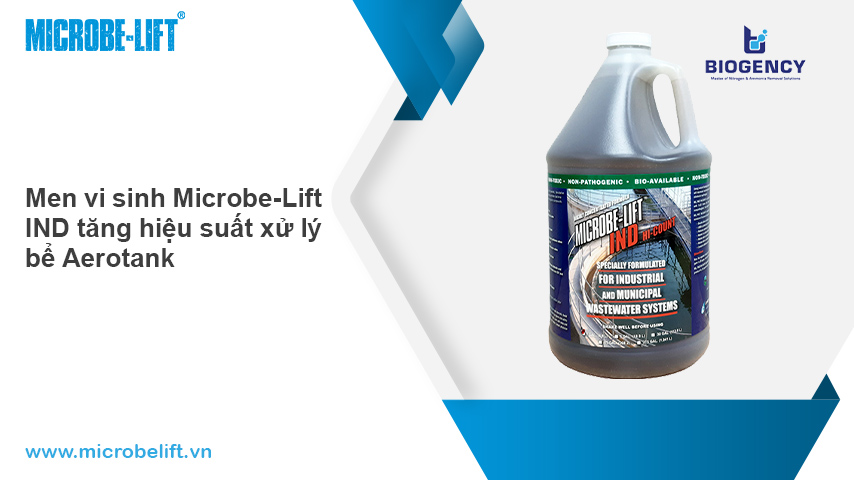
To increase the efficiency of wastewater treatment for bioceramics production in Aerotank, probiotic products containing aerobic microorganisms are added to promote the decomposition of organic matter. As a product containing up to 13 different active microorganisms, Microbe-Lift IND is a probiotic product used for Aerotank that is chosen by many environmental engineers.
Advantages of Microbe-Lift IND:
- Helps increase the density of microorganisms in the biological tank quickly thanks to the product being produced in liquid form, ensuring the viability of microorganisms up to 99%.
- Helps improve BOD, COD, TSS treatment efficiency thanks to containing 13 different strains of microorganisms, 5-10 times more active than conventional microorganisms.
- Able to withstand high pollution loads (COD < 12,000 mg/l and BOD < 10,000 mg/l), helping the wastewater treatment system reduce odors and reduce sludge volume.
If you need detailed advice on how to treat ceramic production wastewater, please contact Biogency immediately via Hotline 0909 538 514, we will support you as soon as possible!