

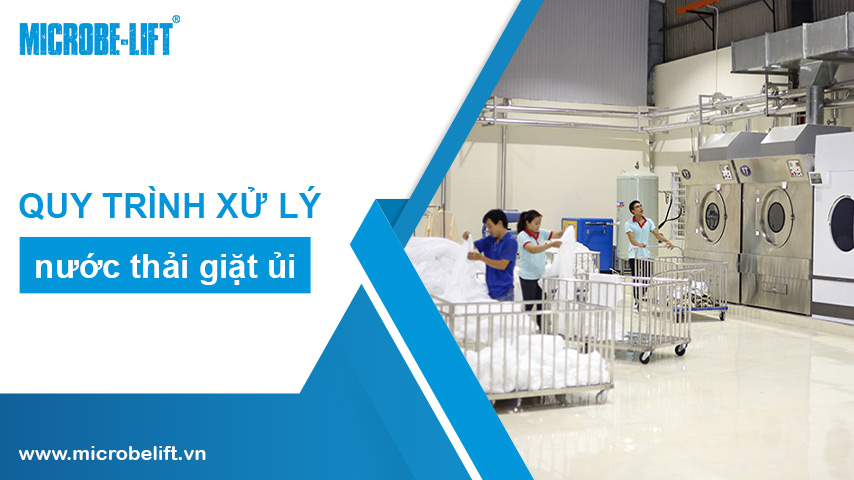
The laundry service industry is a new industry and is currently growing due to the increasing demand of people. Therefore, laundry wastewater has become one of the top concerns for the living environment. If laundry wastewater is not treated properly, it will threaten human health, the living environment and the ecosystem. Let’s follow the article below to better understand the laundry wastewater treatment process.
- Current status of laundry wastewater treatment
- Composition of laundry wastewater
- Laundry wastewater treatment process
Current status of laundry wastewater treatment
The laundry service industry is growing with the presence of thousands of establishments across the country, from small-scale laundry service providers to large-scale factories and companies. In fact, it is undeniable that this service plays an important role in the quality and needs of human life. However, the problem of laundry wastewater treatment is not simple.
With thousands of unlicensed laundry service establishments, as well as the inability to implement strict regulations on wastewater treatment, this is the cause of negative impacts on the living environment. Not to mention, the amount of water used in laundry is not small and contains a large amount of detergents, heavy metals, etc. harmful. Therefore, wastewater treatment needs to be focused on and a specialized treatment system is needed before discharging directly into the environment.
Composition of laundry wastewater
Laundry wastewater is the wastewater discharged from washing and ironing activities of clothes, blankets or fabric items, etc. With the need to clean and remove stains when doing laundry, laundry wastewater will contain mostly detergents, foaming agents, dyes and surfactants. In addition, during the laundry process, wastewater will also contain a part of suspended substances and small fabric fibers.
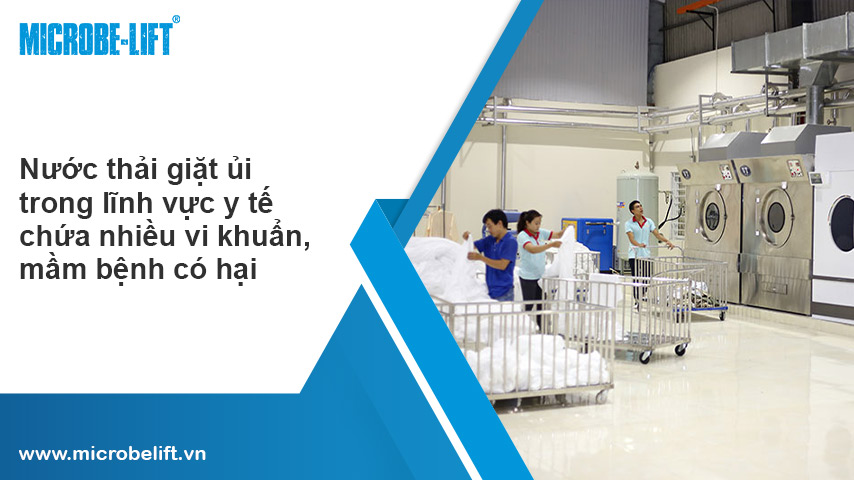
For small laundry services, wastewater will be collected and treated together with urban wastewater. Particularly for industrial laundry services and activities, the output wastewater standard must meet QCVN 40:2011/BTNMT. Specifically:
| TT | Parameter | Unit | C value | |
| A | B | |||
| 1 | Temperature | Celsius | 40 | 40 |
| 2 | Color | Pt/Co | 50 | 150 |
| 3 | pH | – | 6 to 9 | 5.5 to 9 |
| 4 | BOD5 (20oC) | mg/l | 30 | 50 |
| 5 | COD | mg/l | 75 | 150 |
| 6 | Suspended solids | mg/l | 50 | 100 |
| 7 | Arsenic | mg/l | 0.05 | 0.1 |
| 8 | Mercury | mg/l | 0.005 | 0.01 |
| 9 | Lead | mg/l | 0.1 | 0.5 |
| 10 | Cadmium | mg/l | 0.05 | 0.1 |
| 11 | Chromium (VI) | mg/l | 0.05 | 0.1 |
| 12 | Chromium (III) | mg/l | 0.2 | 1 |
| 13 | Copper | mg/l | 2 | 2 |
| 14 | Zinc | mg/l | 3 | 3 |
| 15 | Nickel | mg/l | 0.2 | 0.5 |
| 16 | Manganese | mg/l | 0.5 | 1 |
| 17 | Iron | mg/l | 1 | 5 |
| 18 | Total cyanide | mg/l | 0.07 | 0.1 |
| 19 | Total phenol | mg/l | 0.1 | 0.5 |
| 20 | Total mineral oil and grease | mg/l | 5 | 10 |
| 21 | Sulfide | mg/l | 0.2 | 0.5 |
| 22 | Fluoride | mg/l | 5 | 10 |
| 23 | Ammonium (as N) | mg/l | 5 | 10 |
| 24 | Total nitrogen | mg/l | 20 | 40 |
| 25 | Total phosphorus (as P) | mg/l | 4 | 6 |
| 26 | Chloride(not applicable when discharging into salt water or brackish water) | mg/l | 500 | 1000 |
| 27 | Residual chlorine | mg/l | 1 | 2 |
| 28 | Total organic chlorine pesticides | mg/l | 0.05 | 0.1 |
| 29 | Total organic phosphorus pesticides | mg/l | 0.3 | 1 |
| 30 | Total PCB | mg/l | 0.003 | 0.01 |
| 31 | Coliform | bacteria/100ml | 3000 | 5000 |
| 32 | Total α-radioactivity | Bq/l | 0.1 | 0.1 |
| 33 | Total β-radioactivity | Bq/l | 1.0 | 1.0 |
Laundry wastewater treatment process
Currently, there are many methods applied to treat laundry wastewater such as trickling filtration, activated sludge, chemical precipitation, etc. But the most popular is the coagulation method with the ability to effectively remove suspended solids in laundry wastewater.
The laundry wastewater treatment process is carried out as follows:
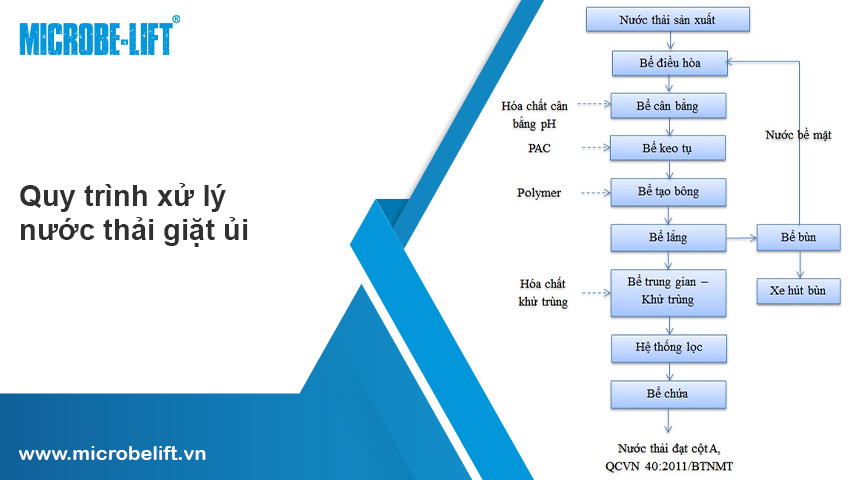
- Laundry wastewater is collected to the trash separator to remove large solid waste. Then, the wastewater is sent to the equalization tank.
- At the equalization tank , wastewater is regulated in flow and concentration and then led to the balancing tank.
- In the equalization tank , pH balancing agents are added to ensure the optimal pH value is maintained from 7 to 7.5 and to serve the coagulation and flocculation process. Next, the wastewater is led from the equalization tank to the coagulation tank.
- In the coagulation tank , the concentration of dirt in the wastewater coagulates together. In this tank, 10% concentration of PAC chemical is used and introduced into the wastewater by metering pump. Using a stirring system to dissolve PAC into water. The colloidal particles formed have the function of bonding the coagulant compounds and suspended substances. Thereby completely removing soluble and insoluble organic substances, bacteria, viruses and heavy metals.
- Wastewater after going through the coagulation process will be brought to the flocculation tank . Here, Polymer solution is added to create a bridge for small residues arising through the coagulation process into larger sludge flakes for easy removal from the wastewater. Using a combined stirring motor to increase the efficiency of the flocculation process.
- After forming large sludge flocs in the flocculation tank, the wastewater is transferred to the settling tank . Using the gravity method, the wastewater is transferred to the central settling tube and under the effect of gravity and the flow baffle, the sludge tanks will settle to the bottom. The remaining water will be collected through the sawtooth trough and then transferred to the intermediate tank – disinfection. The sludge will be collected to the sludge tank.
- Wastewater is sent to the intermediate tank – disinfection to remove harmful microorganisms using disinfectant chemicals.
- After being disinfected, the wastewater will be pumped to the pressure filtration system . This system will help remove the remaining suspended solids in the wastewater. When the wastewater is pressure filtered, it will meet the standards and be discharged into the environment.
- The sludge from the coagulation-flocculation process is sent to the settling tank and then collected in the sludge tank . The surface water is collected and circulated to the equalization tank for further treatment, while the sludge will be discarded.
Laundry wastewater treatment is generally not too expensive in terms of investment in system construction and operation. However, in the process of treatment, it is necessary to use chemicals, so it is necessary to equip yourself with knowledge and protective equipment to ensure safety.
Reference: Textile dyeing wastewater treatment meets standards
If you have any questions about laundry wastewater treatment, as well as solving problems arising when treating wastewater, please contact hotline 0909 538 514 immediately for support and advice.